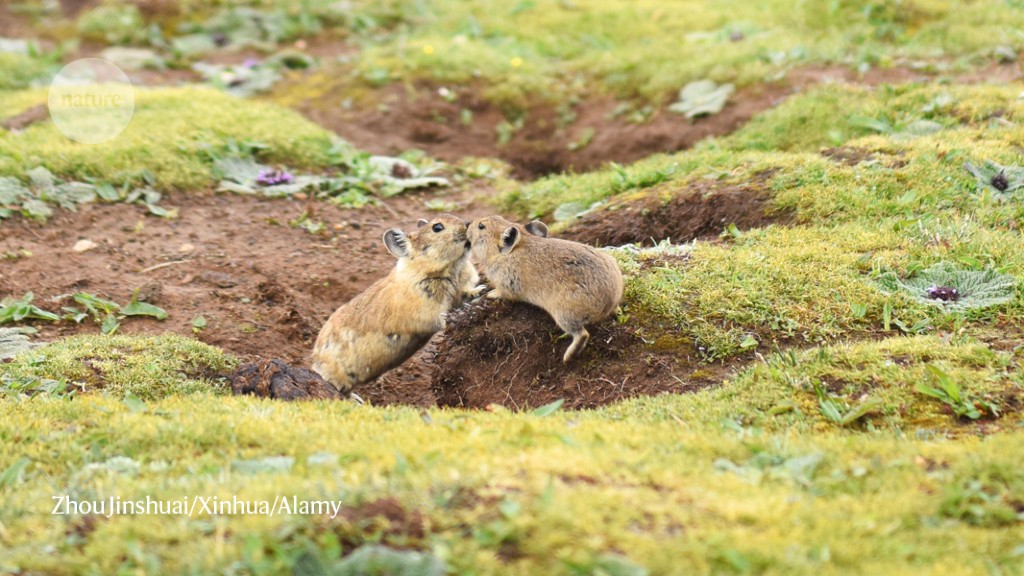
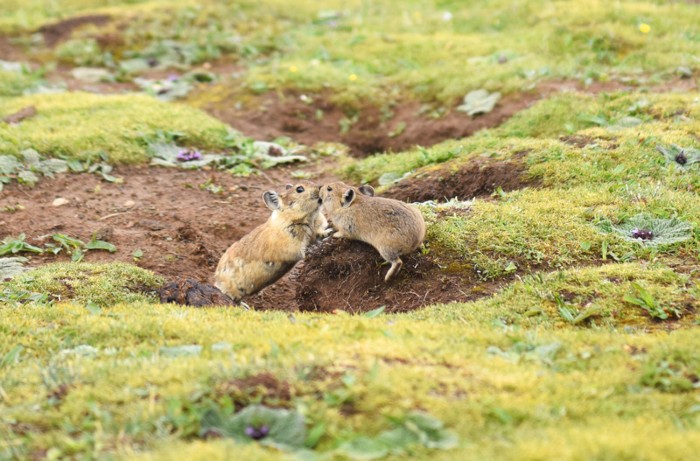
Plateau pikas ‘kiss’ during the growing season, when their metabolic rates are much higher than during the winter. Credit: Zhou Jinshuai/Xinhua/Alamy
Zoology
Pikas in high places have a winter-time treat: yak poo
To survive the harsh winters of their high-altitude home, a fluffball-like animal called the pika becomes strategically lazy — and gorges on yak dung.
The plateau pika (Ochotona curzoniae), a round-eared relative of rabbits, lives on China’s Qinghai–Tibet plateau, where the air is thin and winter temperatures often drop below −30 °C. To understand how the pika, which does not hibernate, survives the cold season, Yanming Zhang at the Northwest Institute of Plateau Biology, Chinese Academy of Sciences in Qinghai and colleagues intensively studied the mammals over 20 field trips between 2007 and 2020.
The researchers filmed pikas and implanted them with temperature sensors. The team also injected the animals with water bearing a distinctive isotopic signature to assess their metabolic rate.
The results show that on average, plateau pikas can lower their daily energy expenditure by almost 30% in the winter. They also rely on an unexpected but nutritious and easy-to-digest food that they can access without expending too much precious energy: domestic yak faeces, which local people also use as fuel.