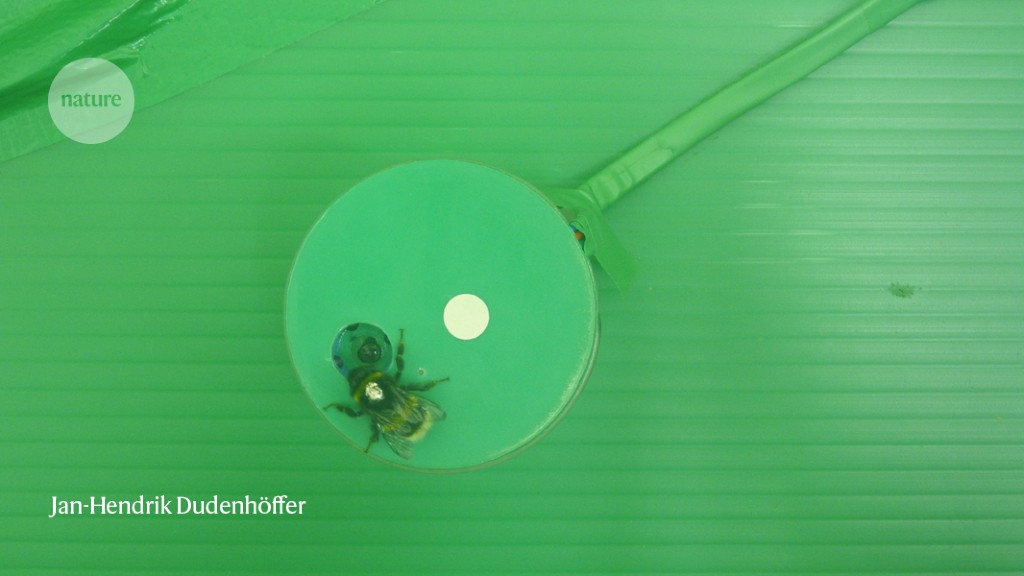
A bumblebee visiting a robotic flower receives a drop of sugar water as a reward. Credit: Jan-Hendrik Dudenhöffer
Animal behaviour
A caffeine buzz gives bees flower power
A jolt of caffeine can help bumblebees to learn to find flowers with a specific scent.
Previous research suggests that bees tend to make repeated visits to a source of caffeine-laden nectar. But is that because the caffeine boosted the insects’ ability to remember a food-rich site? Or were the bees simply craving a buzz?
To find out, Sarah Arnold at the University of Greenwich, UK, and her colleagues taught bumblebees (Bombus terrestris) to associate the smell of strawberry flowers with the taste of nectar. The researchers also slipped caffeine to the bees during this training. The team released the trained, caffeinated bees into an arena dotted with robotic flowers containing nectar without caffeine. Half of those flowers emitted the strawberry floral smell; the rest wafted a standard floral scent.
The bees were more likely to make their first visit to the strawberry-scented flowers than to the other flowers — despite the lack of a caffeine reward. This suggests that the slug of caffeine had boosted the bees’ ability to remember the ‘right’ scent and to find flowers with that fragrance.