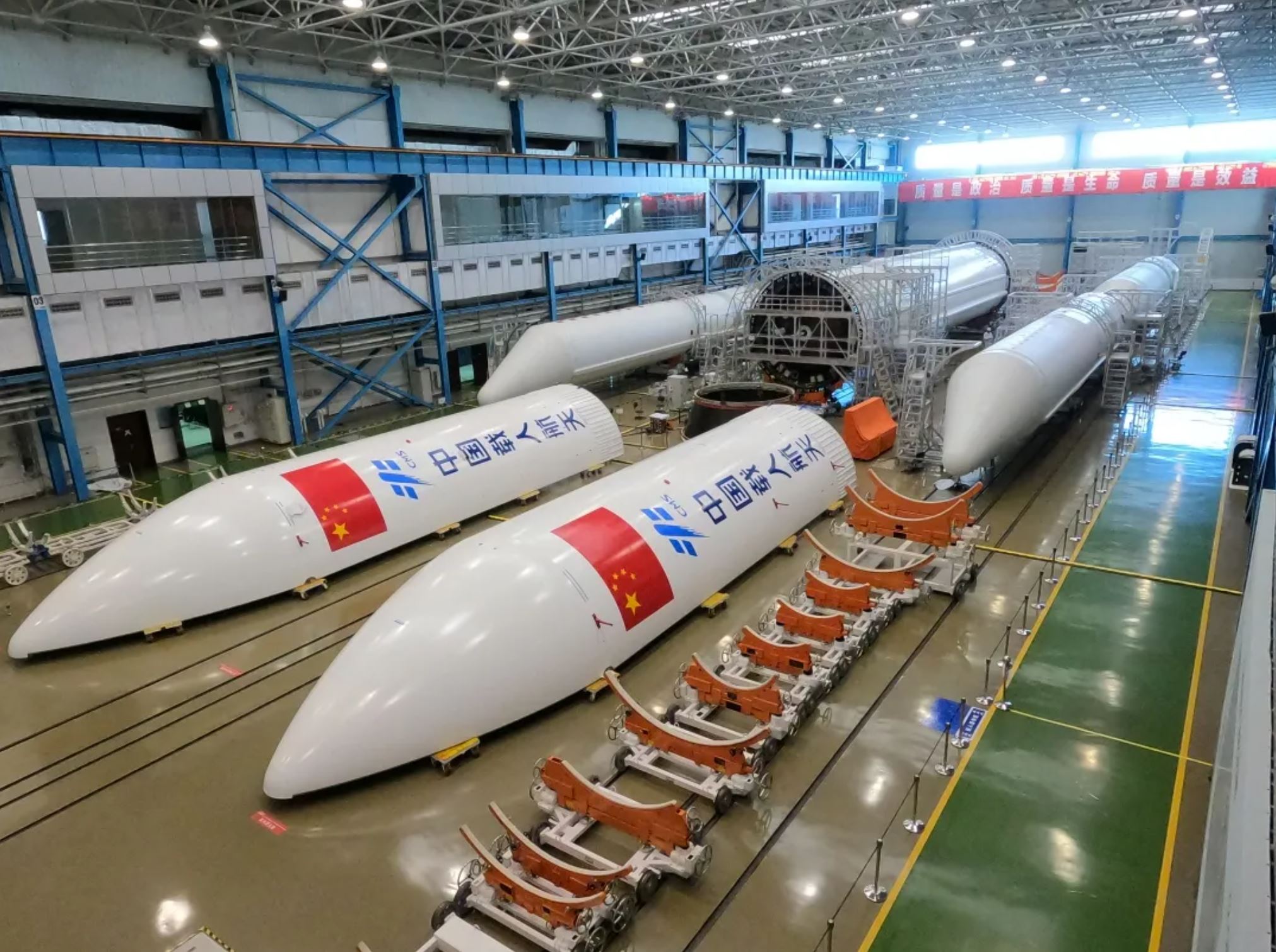
HELSINKI — A Long March 5B rocket has arrived at Wenchang spaceport as China gears up to send its second space station module into orbit.
The components of the third Long March 5B heavy-lift rocket arrived at Wenchang May 29, the China Manned Space Engineering Office (CMSEO) announced (Chinese).
The launcher components were manufactured and tested in Tianjin, north China, and shipped to Wenchang, on the coast of the south island province of Hainan via specially constructed cargo vessels.
Assembly and testing of the launch vehicle is underway. The completed 849-metric-ton, 53.7-meter-long Long March 5B, which consists of a cryogenic core stage, four liquid boosters and an elongated payload fairing, is unofficially expected to launch around July 23.
The mission aims to send the roughly 22-ton Wentian experiment module into orbit to join Tianhe, the similarly-sized core module for the Tiangong space station which launched in April 2021.
The 17.9-meter-long Wentian (“Quest for the Heavens”) module will dock with the forward port of Tianhe, which is currently in a 387 by 386-kilometer orbit inclined by 41.5 degrees.
Three Shenzhou-14 astronauts—due to launch from Jiuquan around 10.40 p.m. Monday, June 5 Eastern—will be aboard Tianhe for the arrival of Wentian and will cooperate with ground control to transpose the new module to a radial docking port using a large robotic arm.
If successful, Wentian would be the second of three modules for the T-shaped Tiangong space station, with the final piece, Mengtian, scheduled for launch in October.
The Chinese space station was first envisioned in 1992 when China approved its Project 921 to develop human spaceflight capabilities. The project suffered delays due to issues with development and performance of the Long March 5B, but could also be expanded to six modules and most commercial and tourist missions.
Wentian features a new airlock for extravehicular activities, a small robotic arm which can work with the larger arm on Tianhe, and additional living quarters that will allow crew handovers.
The first crew handover will take place when the Shenzhou-14 crew greet Shenzhou-15, which is expected to launch in December. Tiangong will then host six astronauts for a period of days.
The new airlock cabin in Wentian will become the main exit-entry point for extravehicular activities (EVAs) once active.
Wentian will also come with 30-meter-long solar arrays, boosting the power available to Tiangong.
Another notable aspect to the mission will be the fate of the roughly 30-meter-long, 21-metric-ton Long March 5B first stage. The core stage also acts as the upper stage, meaning it reaches orbital velocity, rather than falling into a predetermined area on a ballistic trajectory as is most often the case with first stages.
The first two Long March 5B first stages made uncontrolled reentries, gaining widespread public attention.
Two further Long March 5B launches are expected in 2022 and 2023, to launch the Mengtian module and the Xuntian co-orbiting space telescope respectively.