
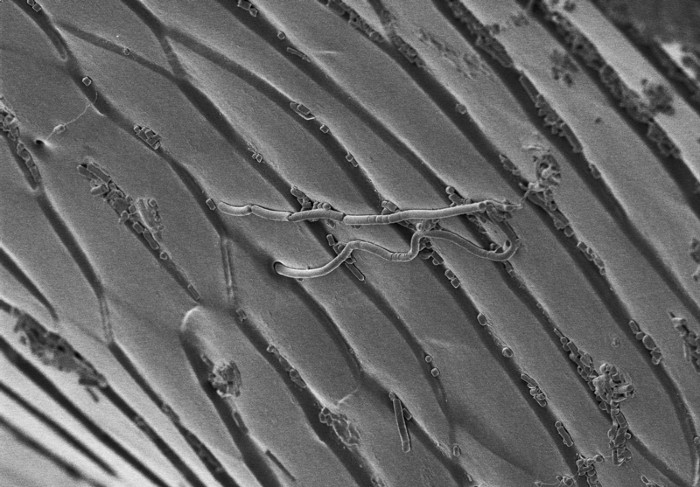
A lubricant seeps from pores on the leg of a darkling beetle. Credit: K. Nadein et al./Proc. R. Soc. B (CC BY 4.0)
Biomaterials
Beetles make ‘Teflon’ to grease their knees
The leg joints of beetles are lubricated with a versatile substance that is as hard-wearing as Teflon.
Until now, scientists have had little understanding of how insects’ joints reduce friction and are protected from wear and tear. Vertebrates have enclosed joints that are bathed in a liquid lubricant, which minimizes friction and helps to protect the surfaces of bones where they meet. But insects have an external skeleton, and their joints are open to the air.
Konstantin Nadein at the Christian-Albrechts University of Kiel in Germany and his colleagues used a scanning electron microscope to image the ‘knee’ joint of the darkling beetle (Zophobas morio). They found that the joint’s surfaces are covered in pores through which a protein-based substance oozes. Chemical analysis found that this is made up of proteins and fatty acids.
When the authors compared this grease to other lubricants experimentally, they found that the substance reduced friction to a similar degree as the chemical coating Teflon. They also found pores and lubricant in the joints of several other species of beetle and a wood roach.