Hello Nature readers, would you like to get this Briefing in your inbox free every day? Sign up here
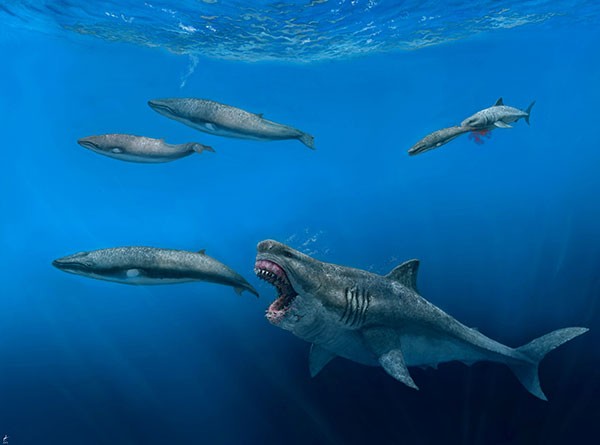
The reconstructed megalodon (Otodus megalodon) was 16 metres long and weighed more than 61 tons. It was estimated that it could swim at around 1.4 metres per second.Credit: J.J. Giraldo
Megalodon shark was longer than a bus
A 3D model of a colossal shark that roamed the oceans millions of years ago suggests that the beast was 16 metres long and could have eaten a whale in just a few bites. Few megalodon fossils exist, but researchers were able to create the digital model using a rare collection of vertebrae and teeth, as well as scans of modern great white sharks (Carcharodon carcharias). They calculated that the ancient creature weighed around 70 tons — as much as ten elephants— and that its open jaw stretched to 2 metres wide.
Reference: Science Advances paper
Features & opinion
The massive eruption of the Hunga Tonga–Hunga Ha‘apai volcano this January was the largest since Mount Pinatubo in the Philippines blew in 1991, and the biggest explosion ever recorded by instruments. Recent data from ice cores suggest that the probability of an eruption with a magnitude 10 or 100 times larger than Tonga in this century is 1 in 6. In the past, eruptions of this size have caused abrupt climate change and the collapse of civilizations, yet little investment has gone into preparing for such an event. Researchers Michael Cassidy and Lara Mani warn that more research is needed to identify risks, monitor active volcanoes and build resilience.
When Kate Jones first held a tiny pipistrelle bat (Pipistrellus pipistrellus) while studying conservation as an undergraduate, it was love at first sight. The biodiversity researcher now uses urban bat populations to study the interface between ecological and human health. “Protecting the natural environment while incorporating it into urban spaces is crucial,” she says. “Ecologists and architects need to talk to each other about the design of our cities.”
A community-led initiative in Peru’s Sacred Valley has created fire-prevention brigades, which aim to stop devastating wildfires before they begin through education and the supervision of controlled burns. “High Andean valleys are fragile ecosystems that don’t repair quickly. Thousands of years’ worth of topsoil can be washed away if it rains after a fire,” says Joaquín Randall, who runs the programme alongside disaster-management officials and volunteers. “It’s much easier to stop someone lighting a match than to put out a 1,000-acre fire.”
Russia’s invasion of Ukraine in February has stirred European interest in ploughing more money into defence research, after decades of being eclipsed by the United States in the field of warfare innovation. In the three months after the invasion, European nations announced increases of nearly €200 billion to their defence budgets, and EU politicians announced a flurry of strategies to boost the bloc’s combined military power, including promises to spend more on the research and development that will stock the next generation’s defence inventories, from drones to artificial intelligence.
Image of the week
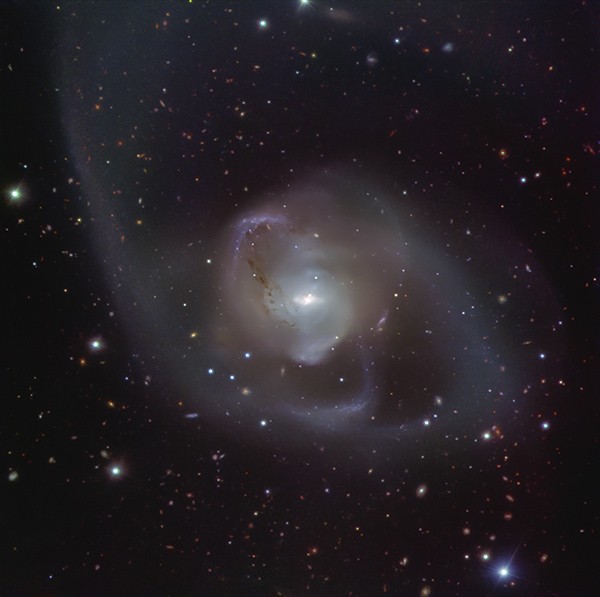
Credit: ESO
This spectacular cosmic collision — a merger of two galaxies that started around a billion years ago — was captured by the Very Large Telescope in Chile. At its centre lies the closest pair of supermassive black holes ever found, two objects that are destined to coalesce into an even more massive black hole.