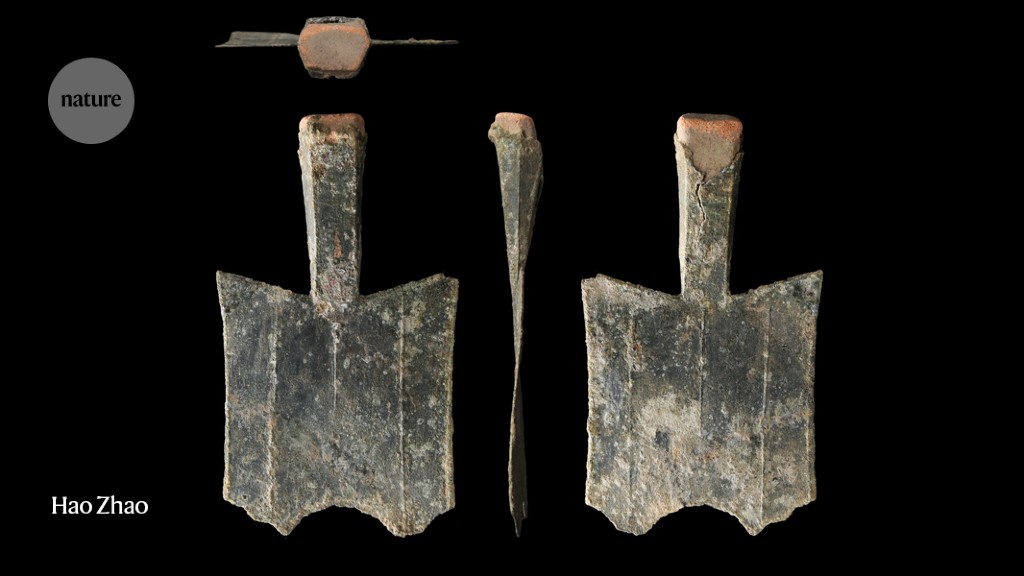
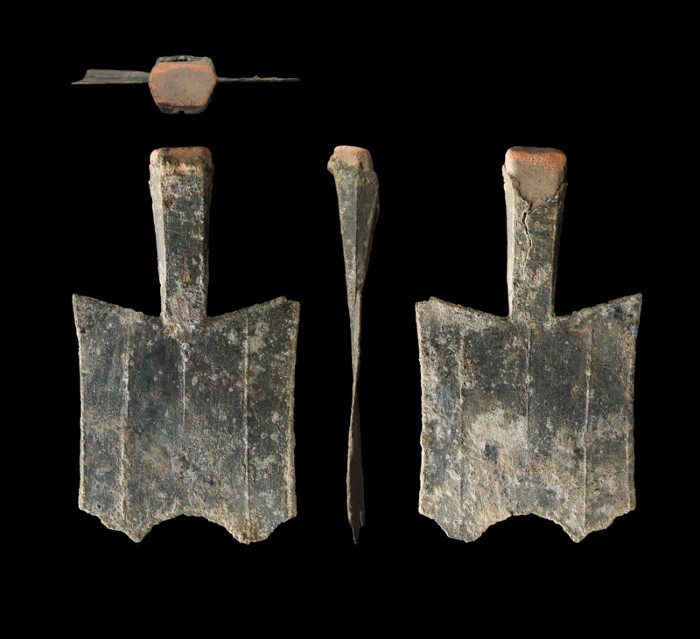
Fragmented ‘spade coins’ found at an ancient mint are the earliest known metal currency in China and possibly the world. Credit: Hao Zhao
Archaeology
Found: the world’s oldest known mint and its jumbo product
The world’s oldest known facility to mass-produce coins started operations some 2,600 years ago in what is now China’s Henan province.
Hao Zhao at Zhengzhou University in China and his colleagues discovered the remains of the coin mint at a bronze foundry that was built around 780 bc. At first, it produced mainly weapons and objects used in rituals. But radiocarbon dating of charred millet seeds in one of the pits used for production waste shows that minting began between 640 and 550 bc — the earliest date that scientists have confirmed for an active mint.
The ruins yielded two fragments of finished spade coins — an early form of money, shaped like the agricultural tool, that circulated in China from the seventh to the third century bc. One of the fragments was so well preserved that the researchers could reconstruct the shape of the intact coin, which probably measured about 14 centimetres in length.
The researchers also found an outer mould and several clay cores for casting spade coins. Some of the clay cores were unused, which suggests that the entire minting process, from making moulds to casting coins, took place on site.