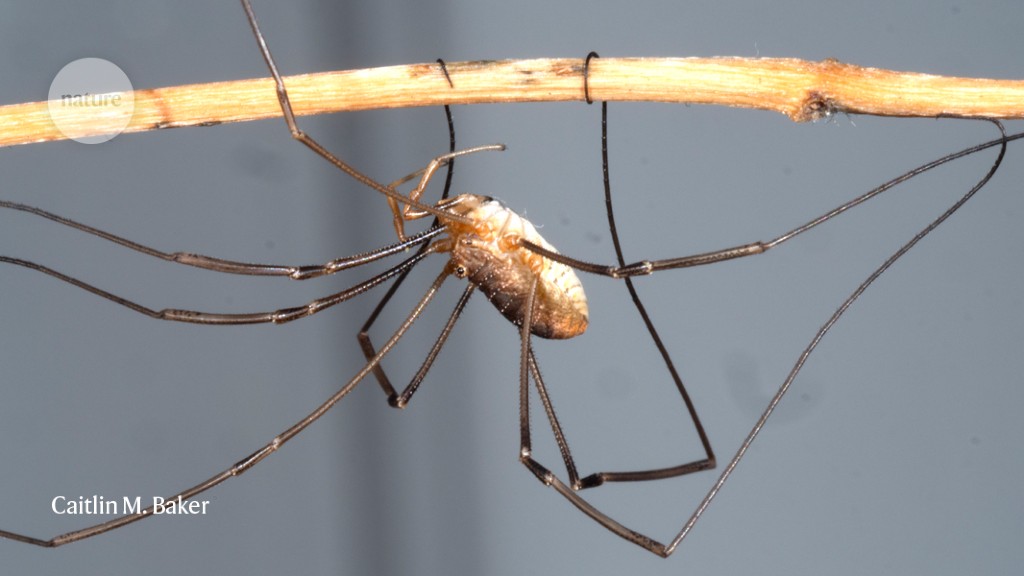
A daddy-long-legs of the species Phalangium opilio. Despite its spider-like appearance, it is a member of a grouping called harvestmen. Credit: Caitlin M. Baker
Genomics
How the daddy-long-legs gets long legs
The first sequenced genome of a daddy-long-legs has revealed the genetic tricks that these creatures use to make their lengthy, grasping legs.
Most of these leggy invertebrates are not spiders but belong instead to a group called harvestmen (order Opiliones). Guilherme Gainett at the University of Wisconsin-Madison, Vanessa González at the National Museum of Natural History in Washington DC and their colleagues sequenced the genome of the long-legged harvestman Phalangium opilio and found that the creature has a single cluster of Hox genes, a type of master gene that influences the body plan of all animals.
By disabling the activity of P. opilio’s Hox genes, the team revealed that several work together to produce its characteristic legs. Disabling a gene in an important growth pathway shared with other arthropods — a vast invertebrate group that includes harvestmen — led to hatchlings with legs that are shorter and less flexible than those of ordinary hatchlings.
The authors’ analysis suggests that daddy-long-legs, insects and other arthropods all have a set of genes that independently gave rise to bendable, grasping legs in each group.