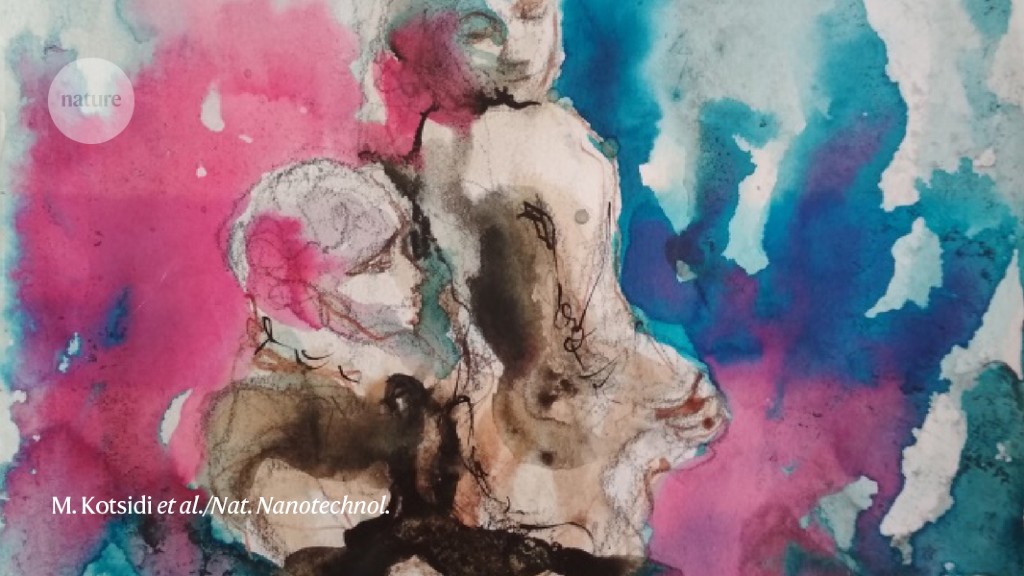
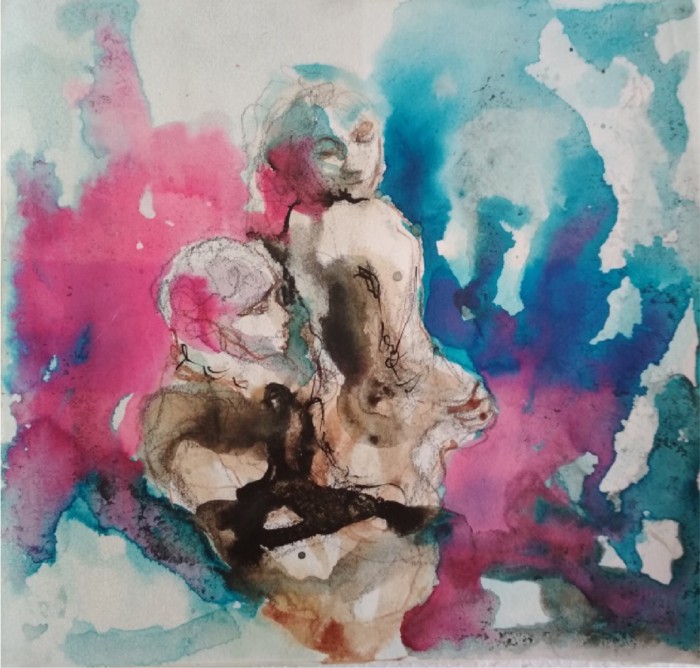
After 130 hours of artificial ageing by visible light, the painting Triton and Nereid has lost some of the purple tint to the figures’ right, but a graphene film kept the bright pink at upper left undimmed. Credit: M. Kotsidi et al./Nat. Nanotechnol.
Materials science
A graphene cloak keeps artworks’ colours ageless
The colours on half of the painting Triton and Nereid faded as it languished in a bright, warm and humid chamber. Those on the other half, however, held fast, protected by an invisible ‘veil’ of graphene.
The ‘wonder material’ graphene can block ultraviolet light, oxygen and moisture — the biggest nemeses of museum conservators. To shield paintings with graphene, Costas Galiotis at the Foundation for Research and Technology — Hellas, in Greece, and his colleagues custom-built a machine to apply the one-atom-thick material to a painting without damaging either.
The machine’s two rollers can gently press thin layers together and unroll one layer from another. The researchers rolled an adhesive film on top of a graphene sheet, then rolled the graphene onto a painting while unrolling the adhesive.
The team subjected Triton and Nereid to conditions simulating more than 200 years of museum display. In that time, the graphene veil did not crack or delaminate. It also was flexible enough to bend with the painting, so it could protect paintings on display or on the move. If desired, the veil can be erased.