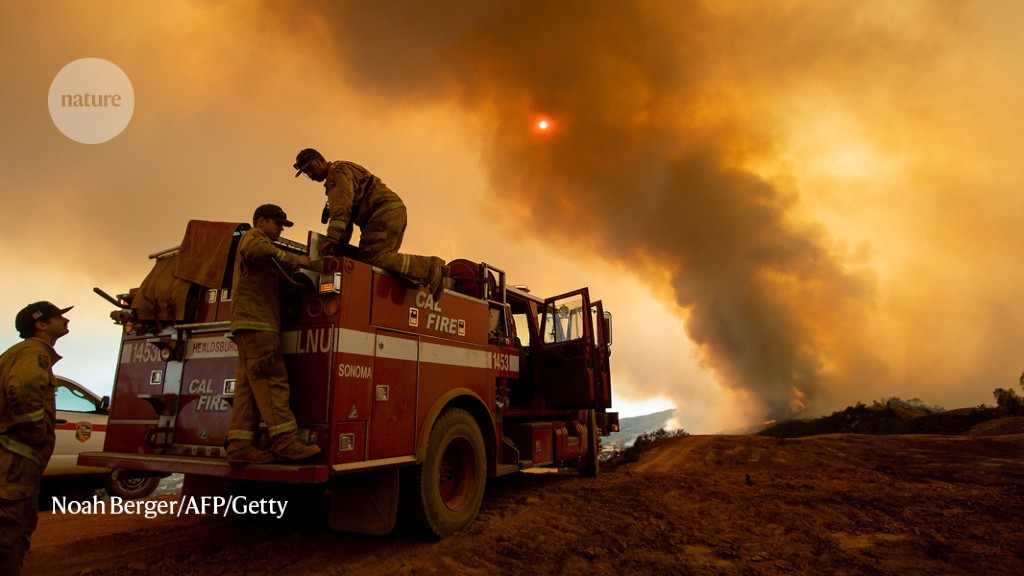
Firefighters battle the Camp Fire in California in 2018. Data from that blaze and others shows that wildfire smoke might brighten clouds. Credit: Noah Berger/AFP/Getty
Atmospheric science
Wildfire smoke creates brighter clouds — and weather changes
Smoke from wildfires in the western United States causes water molecules in the atmosphere to form large numbers of small droplets inside clouds, brightening the clouds and potentially affecting local weather and climate.
Smoke particles can serve as seeds around which water condenses. Scientists have measured smoke’s cloud-seeding effect above many regions, such as the Amazon, while the landscape burned.
In North America, wildfires are charring broader swathes than in previous years, owing to climate change. Cynthia Twohy at NorthWest Research Associates in Bellevue, Washington, and her colleagues flew a research aircraft through clouds and smoke plumes, gathering data on the size and distribution of particles of smoke and other substances.
Compared with clouds in smoke-free skies, clouds in smoky skies formed roughly 5 times as many droplets — sometimes more than 3,000 droplets per cubic centimetre. In smoky skies, the droplets were also much smaller, about half the size of those in clear skies.
As clouds gain more and smaller droplets, they reflect more sunlight, which means they become brighter and produce less rain.